Saturday, June 18, 2022

Father's Day and Finding Balance

Last month for Mother's Day, I shared my opinion that the greatest gift men could give their wives and mothers for Mother's Day is to wake up and behold their suffering. This Father's Day weekend I am wondering if there's a corresponding invitation for men.

I have to conclude that maybe it's the same one: to wake up and behold our OWN suffering, and and see the trouble that comes when we see each other as a role instead of as a person.

With the social pressure men already feel, that "true" masculinity never shows weakness or is emotionally vulnerable (or even admits there is a problem at all) it takes courage to speak about ourselves in ways that aren't considered overtly masculine. It takes courage to acknowledge our own suffering as men and seek support in it. While masculinity is a good, crucial, and even divine part of who we are, there are some aspects of cultural masculinity we have inherited that hurt us, both men and women. It is especially problematic when false binaries based on gender stereotypes highjack a sacrament meeting or Sunday School class.

Now I am going to say something a little bit controversial here, but I think sometimes our gender role fixation built up around post World War II American middle class family dynamics is akin to a modern day golden calf.

Don't get me wrong, I believe in the Proclamation to the World on the Family, and I embrace the teachings of modern day prophets about marriage. I believe that "gender is an essential characteristic of individual premortal, mortal, and eternal identity and purpose." But the model for men AND women that should be lifted up for us to behold, on Father's Day and Mother's Day (and always) should not be based on any particular cultural gender construct. There is nothing in the scriptures that convinces me of that, and plenty of real life experience to convince me otherwise.

Instead, the model that should be lifted up is Christ.

Christ showed us that a person can develop a balance of "masculine" and "feminine" characteristics in oneself without having to rely on a complementary opposite sex spouse to be made perfect/complete. In Christ, we all can learn to become whole individuals, to be "at-one" with ourselves through Christ's at-one-ment, rather than turn into lopsided men and women who can't hardly function without the other one filling in the gaps. And this actually happens. It makes for terrible relationships. The way we make that balance work for us will be as unique as we are, but it must always be a balance.

I will be quick to point out that it is never helpful to judge individuals or leaders when we fall into this kind of idolatry and lose focus on Christ as our model as men and women, but it is helpful to call out the wicked systems that make it happen. We can start by recognizing that a lifetime spent in patriarchy hardens men and encourages toxic masculinity, abuse, addictions, and shame. This is because the feminized traits that we ALL need as men to be made whole are devalued and even feared. This leads to a myriad of social ills.

Christ's invitation is to help heal all that. His invitation is for men to receive His priesthood and exercise it in order to become more tender, to witness suffering and minister to it, to weep, talk about feelings, show affection, nurture youth—to become what some social constructs might define as "feminine." Through priesthood service, we can learn how to balance feminine traits in ourselves while still holding onto our masculinity with an appropriate sense of balance. For those who are fathers, being an active part of raising children can also help us develop those traits naturally.

While so much of patriarchal systems teach men to focus on efficiency and productivity over feelings and connection, to dominate in social hierarchies at all costs, or to amass wealth and seek after individual accomplishments, many men choose to reject that model and reorient themselves towards a balance of masculine and feminine qualities. Fatherhood can help make that happen, but it doesn't happen automatically. It isn't even instinctive. The natural man has always been "an enemy to God." 

And that's why I honor the many men, especially my own father, who deliberately work to protect a space for community and the feminine collective spirit to flourish. I am grateful to know men who know how to do this very well, and even wear out their lives trying to make it happen.

No father is perfect at this. "We have learned by sad experience that it is the nature and disposition of almost all men, as soon as they get a little authority, as they suppose, they will immediately begin to exercise unrighteous dominion." (D&C 121:39) We know Christ's priesthood "cannot be controlled not handled, only upon principles of righteousness." (vs 41) This is a near impossible task in a power structure that is totally invested in encouraging men to do exactly the opposite of what Christ invites us to do. But we keep on trying, anyway. 

I see the suffering of men as they try to provide for their families without getting consumed in the process. I see the struggle of men who confront a system that attempts to turn our divinely ordained diversity into 9-5 drudgery,  making us a cog in an economic machine that everlastingly tries to separate us from our wives and families. I see the suffering of men who are taught by the devil to fear emotional vulnerability and to run away from beholding our own weakness.

But I also see the many good men who have chosen fatherhood in the fullest sense of the word: men who use their privilege in a patriarchal society to sacrifice and serve to help foster a place for families to flourish, transcending nonsensical gender labels in order to restore masculine/feminine balance in our communities, in our marriages—and most of all in ourselves. 

Friday, May 6, 2022

Mother's Day and Raising Lazarus

Parenting is hard

Having some experience being the stay at home parent, one thing I learned about taking care of kids is not only how much suffering is involved in being a caregiver, but how invisible you feel in that suffering. A person doesn't really need someone to tell you how wonderful you are, or how you have some natural ability to do things another person just doesn't want to do—things that feel anything but natural, like cleaning up vomit at 4AM or spreading peanut butter on pickles. Telling a person they are somehow divinely designed for hardship could end up making them feel even more invisible in their suffering than before. 

No one likes a pedestal. Sometimes what a person would really like is to be seen in their suffering and then have some real help.

Sometimes I wonder if on Mother's Day men end up giving talks or sending cards that are more about making ourselves feel more comfortable with the status quo of gender dynamics than they are about validating the real difficulty of motherhood. So what would be helpful? I think Mother's Day is an opportunity for us all, especially men, to behold the suffering associated with motherhood, and then step up to do what we can to help. 

In the Garden of Eden, we might consider God's words to Eve as a kind of prototype Mother's Day talk, a precedent for how to approach the topic of motherhood. It went like this:

"Unto the woman [God] said, I will greatly multiply thy sorrow and thy conception; in sorrow thou shalt bring forth children." (Genesis 3:16)

No platitudes or candy-coating there. Try slapping that on a Hallmark greeting card and sending it out for Mother's Day. But the point, I think, is that the first thing God did was acknowledge the suffering that comes with being a "mother of all living." While men have a corresponding sorrow mentioned a few verses later, only women's sorrow is multiplied, because Eve's suffering turns into much more than just what a woman experiences in actually bearing children.

As men on Mother's Day, we get to choose whether to minimize the suffering of women and mothers in order to make ourselves more comfortable about it, or to stand as a witness to their suffering, to validate it and acknowledge it the way God did for Eve in the garden. Witnessing their suffering first may help us to know how to be a better support.

I don't think I am being controversial when I say that Mother's Day tends to minimize suffering. Men stand in line at Costco to throw some flowers or a nice meal at their wives' or mothers' suffering and hope for the best. Though motherhood certainly is a glorious part of the plan, a Christ-like act, a selfless endeavor, a tremendous triumph of love and creation, someone has to stand up and say that wiping noses and breaking up fights and staring into the abyss of your own inadequacy as you create and raise up actual people just sucks sometimes. And the suffering doesn't end when children grow up, either.

Perhaps we can acknowledge that suffering is as much a part of delivering us physically, the way our mothers do, as it was for Christ to deliver us spiritually. This parallel suffering and deliverance between birth and rebirth is referenced by Elder Holland in his talk "Behold Thy Mother!" and has me thinking of what it means when we promise to stand as witnesses of Christ. Maybe that can also mean witnessing the suffering of others, the way Christ did. For men on Mother's Day, perhaps that means especially witnessing the suffering of women, and maybe doing a little more trying to alleviate their suffering, and a little less of contributing to it.

I have noticed in myself that there is something uncomfortable about witnessing suffering, and I think this is especially common for men. Too often we want to fix it, explain it, reconcile it, contextualize it, or incorporate it into something more palatable to our own male experience. Perhaps this might even be because we feel some measure of guilt to recognize that we are actually complicit to women's suffering, because we are doing things (or not doing things) that directly contribute to their pain. But other times our discomfort might not be our fault necessarily, but come from simply living in patriarchal systems that tend to hurt women but benefit ourselves.

But most of the time, suffering has no words and no explanations. Some pain has to simply be felt and some wounds have to be witnessed by others before they can be fully healed. For example, there is no easy resolution to the fact that creating a human child hurts a woman a heck of a lot more than it hurts a man. The act of birth can literally tear flesh. There is no theological explanation for that inequality.

For hundreds if not thousands of years, men made themselves scarce during that sacred, painful act of delivery for their children, unable to stomach the anguish of their wife and behold the blood and horror of it all. Birth was something to be witnessed only by women, and men had no part of it. That has changed now. What can a man learn witnessing the suffering of childbirth? Maybe some humility.

For me, I remember how useless and bewildered I felt in that final, excruciating act of creation performed by my wife for each of our five children. Before I watched the birth of my first child, I had conjured up in my mind an idea that creation of human life is some kind of equal partnership between men and women, but it turns out that all I could do in that moment was just stand there like an idiot and witness something that was so one sided that it made my one night's tiny half cell contribution almost laughable.

Importantly, not all of the pain of motherhood is physical pain. As God says, sorrow "multiplies" from conception. I saw this first hand during the pregnancy of our last child, when my wife's emotional and mental pain was so intense she was hospitalized in the psychiatric ward. Just as I felt helpless during the actual labor, I also felt helpless then, visiting her in the hospital with some ridiculous cupcakes, trying to understand an emotional burden that was simply beyond my understanding. But at the very least, I could be with her and witness her pain.

Furthermore, the pain of a woman does not always correspond to being a mother at all. For some women, the pain includes not being a mother or a wife, or simply not fitting the mold of a patriarchal society at all. For some the pain involves an abusive relationship, past trauma, or simply the pain of being overlooked. Whatever the suffering is, as brothers, fathers, husbands, bishops, ministers, we need to wake up and see it, and not minimize it into Mother's Day platitudes for our own convenience.

Waking up Lazarus

In the scriptures, Christ spent much of his time waking up men. In the garden of Eden, the relationship between Adam and Eve began with Adam asleep while Eve waited for him to wake up. This seems to be a trend in many relationships, including mine. In another garden, Gethsemane, Christ's disciples were also found asleep, the way Adam was, when He asked them to witness His suffering as He performed for them the harrowing act of spiritual delivery, the atonement, in much the same way that our mothers delivered us through the suffering of their own bodies.

The atonement of Christ took place in two stages. The first, as I mentioned, was witnessed by men in the Garden of Gethsemane and seemed to be focused on the physical and emotional pains and sorrows of all humankind, which caused Christ to bleed from every pore. It was a bitter cup that even Christ shrunk away from.  He asked his disciples to watch with Him three times, but each time He found them asleep. He said, "What, could ye not watch with me one hour?" Apparently they could not. Their spirit was willing, but their flesh was weak.

The second act of the atonement, we learn, took place on the cross. This was specifically witnessed by women, including His own mother who watched and waited with the Savior until He announced, "It is finished." These two acts of the atonement included two separate witnesses, male and female. Significantly, there were no women asleep at the cross.  The final act of spiritual delivery was witnessed by a demographic that perhaps knew better than men something about watching and waiting and witnessing the pains of giving birth as they watched Christ spiritually bear us so that we could be "born again."

But what about those sleepy men? And how are we like Christ's disciples in the garden? Men who receive the priesthood take upon themselves a covenant specific to them, inviting them to wake up:

"O that ye would awake; awake from a deep sleep, yea, even from the sleep of hell, and shake off the awful chains by which ye are bound...Awake! and arise from the dust...Awake, my sons; put on the armor of righteousness. Shake off the chains with which ye are bound, and come forth out of obscurity, and arise from the dust." (1 Nephi 1)

So much of priesthood leadership in the Church of Jesus Christ of Latter-Day Saints is an invitation for men to wake up and behold the suffering of others, especially women. Three men are called to sit on the stand each week and supervise the breaking and passing of the emblems of Christ's suffering to His people, the way Peter, James, and John witnessed the body and blood shed for us in the garden of Gethsemane. This is an invitation that perhaps, this time, men will not be found asleep as they consider the ways Christ suffers with His people. I am not convinced we are doing this yet, but I do believe the priesthood has the potential to help men change the world, starting with themselves, and to see firsthand the wounds of patriarchy and then work to heal them, to spur men to get over themselves and move the world toward gender equality and Zion.

The final mortal miracle of Christ according to the gospel of John is also His most impressive: raising Lazarus from the dead. Lazarus is the brother of two of Jesus' closest friends, Mary and Martha. These two sisters send for Him to come heal their brother, but instead of coming right away, Jesus purposefully tarries a few days. When He finally gets ready to return to Judea to heal Lazarus, Jesus goes out of His way to explain that Lazarus is not dead, but sleeping:

"Our friend Lazarus sleepeth; but I go, that I may awake him out of sleep. Then said his disciples, Lord, if he sleep, he shall do well. Then said Jesus unto them plainly, Lazarus is dead. And I am glad for your sakes that I was not there, to the intent that ye may believe; nevertheless let us go unto him." (John 11)

Upon reaching Mary and Martha, their grief was so great that Jesus "groaned within Himself." Lazarus had been dead and buried four days, and Martha came running to Jesus saying "Lord, if thou hadst been here, my brother had not died." While Martha was comforted by Christ's testimony that He was the Resurrection and the Life, Mary's grief was so great that she could only sit within the house. She was inconsolable.

When Jesus commanded that the stone be moved away, Martha's first concern was for the smell, saying "Lord, by this time he stinketh: for he hath been dead four days." But in spite of the impossibility of such an act, to bring to life a body so far gone in decomposition, Christ succeeded in raising Lazarus from the dead, to unbind him from the grave clothes and untie the napkin on his face.

Waking up men is something Jesus specializes in. I believe there is much symbolism in this story of Lazarus, a reminder that Christ has the power to wake men out of sleep even if that sleep is so deep they are actually dead and rotting. Lazarus is a metaphor for all men in Israel whose sisters weep outside the tomb, hoping against hope that they can be woken up by Christ's call to "Come forth!" This call, as I mentioned, comes in the form of priesthood service.

In the latter days, I believe Lazarus wakes up by degrees. Jesus taught, "He who is greatest among you, let him be your servant." The burial clothes Lazarus is bound in could remind us of the robes of the priesthood, and that each time men repent and put off the natural man and exercise their priesthood, overcoming the universal tendency for unrighteous dominion (D&C 121) that results from gender hierarchies, and respond to the call to minister to help relieve suffering, we all get a little bit closer to Zion.

In that process of raising Lazarus, many will need to be comforted. Some women might be more like Martha, content with the current explanations about the role of women, with hope that things will be better in eternity the way Martha was comforted by Christ's testimony to her. But some women might be more like Mary, whose pain was so great that she "remained in the house" and wouldn't come out for that Mother's Day sacrament meeting. Sometimes the explanations simply do not help. But whether we are ministering to a Mary or a Martha, our task is the same: we need to wake up.

When Mary and Martha suffered, it says "And many of the Jews came to Martha and Mary, to comfort them concerning their brother." This is something we all can do to prepare ourselves for the day that Lazarus will be fully raised from the dead. Christ's Second Coming cannot happen until Lazarus is awake. Though Christ tarries today like He did in coming to Bethany, the sleeping men caught under the spell of patriarchy will eventually wake up, and we will witness with wonder Christ's power to perform His work and succor His people.

"The Raising of Lazarus after Rembrandt," Van Gogh, 1890

Sunday, February 6, 2022

Tower of Babel

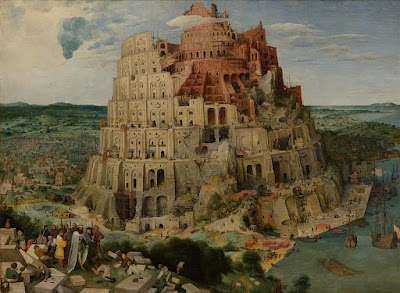
The (Great) Tower of Babel, Bruegel the Elder, 1563

What is the difference between building Zion and building the Tower of Babel, when both stories are about trying to build our way to heaven? How do we know which work we are engaged in? We can know by whether or not we are listening to each other.

The people in the Old Testament were trying to get closer to God. I doubt we are supposed to take the story literally, that these people were actually dumb enough to think they could build a tower high enough to reach heaven, but there is good symbolism there.

"'Go to,' the people said, 'let us build us a city and a tower, whose top may reach unto heaven; and let us make us a name, lest we be scattered abroad upon the face of the whole earth.' And the Lord said, 'Behold, the people is one, and they have all one language; and this they begin to do: and now nothing will be restrained from them, which they have imagined to do. Go to, let us go down, and there confound their language, that they may not understand one another's speech.'" (Genesis 11:4)

In today's polarization, we are likewise confounded in our language. Sometimes, we legitimately do not understand one another's speech. When I talk with someone about certain political issues, I sometimes wonder if we are speaking in foreign tongues. So many things break down in translation. "Freedom." "Common good." "Rights." "Responsibility." We have lost the ability to communicate different perspectives with much degree of comprehension or common ground, and I appreciate that it is as much my fault as anyone else's.

Why would God confound us, members of Christ's church trying to build His kingdom on the earth? Sometimes, I think, it is because we have forgotten that we are building Zion where there are "no poor among [us,]" and have instead been building a tower of Babel in its place.

For a long time, and emerging out of a complicated cultural framework in the early 1900s, we had at last developed a solid core name to be known by, an unofficial "Mormon" identity that involved a certain culture, politics, language, and which abided by grammatical rules of what it meant to speak properly about being a latter-day saint. Those who didn't speak that language were, to our detriment, often pushed out. Our identity eventually became less and less about our belief in Christ and his gospel, and more to mean a certain political orientation and certain set of social expectations. At the time, it was easy to work together this way, all of us predominantly located in the intermountain West and superficially united in the same cultural language. But the polarization of our world has changed all that. It has pointed us to the fracture lines in our foundation. Like the Salt Lake City Temple, we need a renovation. 

As we internationalized and faced more complex social issues at home, our makeshift language that we constructed as a defense against the world "lest we be scattered," lacked the vocabulary to move forward. We  became mired in an identity that tends toward exclusivity rather than inclusivity. From here on out, if we are going to move forward we are going to have to adapt and focus on our common faith in Christ regardless of our social or political views. We need to value our differences, instead of marginalize them. In short, we are going to need to learn to speak one another's languages.

In the day of Pentecost, there was an outpouring of the sign of the gift of tongues. I believe we need this gift now more than ever. Not necessarily literal languages, but we need ways to interpret each other's differences with edification and rejoicing. Every day I lack this gift! But with each of us and our thick pioneer accents that hail from a multitude of different motherlands, we must learn to understand one another. Our ways of gesturing and communicating will vary depending on our life's experiences and a variety of political and social backgrounds, but taking time to listen to someone who speaks differently is going to be necessary work. It will enrich our church with diversity. It is the gift of interpretation of tongues. Without it, there will be no Zion, only the Babel of the 6:00 news.

The common language, the one we shall never throw away because it is the everlasting alphabet of our Savior, is the gospel of Christ. It is the language of Zion, the means to make a society consist of the "pure in heart" and where there are truly no poor among us. Christ's gospel language demands a rhetoric of bold defense for the most vulnerable among us, rather than focusing on ourselves. Christ's gospel is the language of service, inclusion, and love. Without learning to listen with love, our work will look less and less like Zion and more and more like the Tower of Babel, or perhaps even like Lehi's vision of the great and spacious building.

Tuesday, February 1, 2022

On Convoys and Caring


We talk a lot about a health care system because that's what it is. It's a system. Like any other, it is based on efficiencies and statistics and bottom line dollars. We analyze bed capacity and staffing and projections of possible admissions, equipment needs, budgets, vaccination rates, and skill sets. Like any system, it has hierarchies and values, and choices must be made every day about which values have priority.

So it is not surprising that some people feel lost, unheard, and invalidated in this system. It is a real problem. More than anything, I am concerned that many people are losing their trust in this system altogether, especially their trust in health care providers, as legitimate questions about a rapidly changing pandemic come about as quickly as the tidal waves of information and misinformation that try to answer them.

When we have a question about the wiring in our houses, we go to an electrician. When we have a question about migration patterns of dolphins in the Gulf of Mexico, we ask a marine biologist. But for some reason, when it comes to our own bodies, more and more we are turning to the people on the internet, many whose credentials are inflated or entirely misrepresented, and then turning around to call the ones who have spent their entire lives studying the human body and epidemiology untrustworthy. What is going on here? Are some people just idiots? Or could there be some problem with us in healthcare?

Now, I am hardly some veteran, experienced nurse over here by any means, but I have done some thinking and tried really listening to a lot of people with different perspectives than mine, and while I still think many are totally quackers, I have come to the conclusion that not everything is their fault. I think part of the blame is with us. It is my opinion that much of the pandemic fallout shows us that our healthcare system could use some tweaking.

I hear many people who feel like their concerns about vaccines and side effects often go unanswered as we rush them through the system like a production line in a factory. The drive to vaccinate has always been about numbers, statistics, and a race against time, and to some degree rightly so. But we all know that one of the biggest problems in this pandemic has been that people are not feeling heard or seen. Some people feel talked down to or ignored by their health care providers in the rush to protect the public and stop the spread, or just because we don't have time or energy to explain the same thing one more time. Some people feel like they are even treated like the enemy because of their health beliefs. Some honest questions are met with derision or a brush of the hand instead of an attempt to give thoughtful answers. This has to be, in part at least, our own fault. The metaphorical call bells are going off somewhere else in the ward and so we triage, we prioritize, and sometimes we just don't have time to explain why we are doing what we are doing, Mr. Jones, so please just sit down and take your dang medicine because we don't have time for your shenanigans.

Right now a trucking convoy for freedom, with a lot of my friends hollering their support, is a symptom to this problem of not feeling seen or heard. The pressure has been building for a long time. It is hard to listen to and see the answers from someone when you don't feel listened to or seen by them first. It speaks to a demographic who hasn't had their concerns acknowledged for two years. In my church we teach that 

"No power or influence can or ought to be maintained...only by persuasion, by long-suffering, by gentleness and meekness, and by love unfeigned; by kindness, and pure knowledge, which shall greatly enlarge the soul without hypocrisy, and without guile—reproving betimes with sharpness...and then showing forth afterwards an increase of love toward him whom thou hast reproved, lest he esteem thee to be his enemy." 

As I see many who now esteem scientists, government officials, and even healthcare providers as their enemies, I wonder if we need to re-evaluate how we do things.

Any system like ours naturally thrives on administration and bureaucracy. We all know this. Rules and policies and rollouts and shareholders are what steer Alberta Health Services, not the benevolent nurse who holds hands and validates feelings. This does not mean administrators do not have their place. We need administrators and science informed policies and quality control and someone to balance a budget. But it isn't enough. It is not a balanced system if we don't carve out and protect a space for caring and compassion and listening and nurturing and a whole lot of patience. And I think this is what is missing today.

In any system there is a Yin and Yang of feminine and masculine qualities to make things run smoothly, but more often than not, the masculine qualities of efficiency and quantifiable production will beat out the feminine qualities of the compassionate, caring nurse every time. Because newsflash! We are living in a patriarchal system. We value masculinized characteristics over feminized ones. It's the very air we breathe, and healthcare is a pretty good case study for it. The administrative qualities will rise to the top and the nurturing qualities of caring will remain unpromoted at the bottom.

After the physician strolls in and gives the diagnosis and writes the prescription, he will have to move onto the next one, because this is an assembly line model with a waiting room out there full of other patients, and with specific billing procedures to follow. Most policies are formulated with the business model in mind. Almost all physicians I know are furious with recent changes in our province that make it even more like an assembly line, with artificial quotas and red tape that put unnecessary restraints on a physician's ability to take time and care. Meanwhile, on the other side of the team, nurses are facing the cutting block in virtually every budget meeting, and it is a constant fight to even keep our place in the system at all! Some suggest that humans in healthcare could be replaced with an App. Obviously, this is an imbalanced system. This is not news to anyone who works in health care, and we generally work out that balance between efficiency and caring in our practice as best we can.

Every nurse I know starts out caring deeply about people. They are naturally drawn to a profession that values listening, taking care of people, talking with them, alleviating suffering, and teaching. But more often than not, the system doesn't allow much time for that. When you are short staffed on the floor and the bells are ringing, the expectation is that you get the job done, even if it means treating people like pieces of meat in a factory as if everyone just needs a pill and a wipe and then you can send them out the door as fast as you can because the hospital is in overcapacity again. A nurse can quickly become jaded in such a system. There is a good reason you might get greeted by a tired, crusty, burnt out nurse who doesn't have time for your questions. It isn't that she or he doesn't care. They probably cared too much. But when you are treated like a cog in a factory, it will get to you eventually, and it isn't necessarily our fault.

Mind you, there are so many heroic caregivers that go above and beyond every day to take time to see the people instead of the numbers. But it is largely unsustainable in our current model. Anyone who cares deeply about people in this system all the time will burn himself or herself out. So you learn to ration your feelings and your caring, because compassion is not an inexhaustible resource. The time taken to explain treatments and answer questions and provide education about medications including vaccines to a blustering Mr. Jones is about maintaining an attitude of caring, sometimes superhuman acts of caring, and more often than not, this is the part that gives out well before the physical exhaustion sets in. 

This side of health care, good nursing care, cannot be valued properly when the entire system is based on a masculinized business model where the bottom line is efficiency and people's health become the commodity. The pandemic has put even more pressure on us, and the gaps are glaring at us even more than they were before.

There is so much about our health care system to love. Socialized health care for all is something I am fiercely enthusiastic about. But I know not everything we are doing is working great right now. For one thing, voting for policies and governments that continue to gut the healthcare and education system in the name of freedom and a dollar will not work for me anymore. For another thing, I despair to see more and more people I know turning to the wild west of the internet for their scientific and health information, wading through garbage because they don't know the difference between politics and peer review. But I can't blame them. There is a reason they don't feel comfortable to turn to their own health care providers for clarification. How would they even get an appointment? To me that is the most alarming thing.

As I watched this past week's freedom convoy, battling between feelings of charity and disillusionment, I began to wonder what freedom and caring even means anymore. What it means to me. What is freedom without caring? Without truth? Without responsibility? As caregivers drown in the impossible task of single handedly educating a nation, of listening to people mired in conspiracy fears and trying desperately to earn back the trust of a demographic that has become more and more disillusioned, and all this while we face the unrelenting workload of saving lives in a short staffed and burnt out fifth wave, it becomes obvious there will be no convoy on their way to Ottawa demanding support for nurses and healthcare providers anytime soon.

Saturday, January 15, 2022

"It Shall Be Well With Him"

 "And now abideth faith, hope, charity, these three; but the greatest of these is charity." (1 Cor. 13:13) It has been helpful this week (for me anyway) to look at these three Christian virtues as they are situated in time. 

1. Faith


In a lot of ways, faith looks into the past. It is the evidence of things not seen, the substance of God's works as they have unfolded to us previously in human experience, either anciently as recorded in the scriptures, or in our own more recent family and personal experiences. Faith is a power of action. We build on past faith by "experimenting on the word," (as Alma puts it) which comes to us "like a voice from the dust" from the past to propel us forward into the unknown. Faith is not blind believing, but acting on past evidence. In some ways, faith is always dependent on the past. It is the "faith of our fathers [and mothers,]" the foundation upon which we, their children, must build. It is our first step in the gospel that connects us to God, but every step of faith we make, as soon as it is taken, becomes another part of the past upon which our discipleship is built.


2. Hope


If faith arrives to us from the past, hope always points us to the future. In Spanish, "to hope" is the same verb as "to wait." It is future tense, waiting with conviction for better things. It is the power that helps us see beyond the mortal muddle we are in, whatever feeling or emotion that drags us down in our lives. We hope for a future time where negative emotions or experiences can be resolved. We hope that some day we can sit down together in heaven through Christ, in a state of peace and total acceptance and with a perfect restoration of lost loved ones and lost blessings. Hope is the "anchor to our souls." (Hebrews 6:19) It is what helps us to make sense of less than ideal circumstances. Hope looks forward towards the ideal of what we and our fallen world can become in Christ.


3. Charity


But, of course, a life cannot be lived in either the past or the future, because it must be lived in the present. The most important time frame is now. We cannot focus our living on the experiences of the past, nor to the hope and idealism of the future at the expense of today. However much we would like to escape the discomfort of the present, to the suffering of the human experience around us on any given day, focusing solely on the past or future does not allow space for the crowning Christian virtue, which is charity, the pure love of Christ. Without His love today, our faith and hope in Christ is "sounding brass and tinkling cymbal," for without charity, we are "nothing." (1 Cor. 13) And so our lives must be spent trying to ground ourselves in the present, connecting with the beauty, humanity, and suffering of ourselves and the people around us by practicing love.


Charity is given to us only as we seek for it, pleading "with all energy of heart" that we might be filled with this love. (Moroni 7) Unlike faith and hope, which can be cultivated in solitude, love is relational. It forces us to connect to each other so that we can knit our hearts together in love. (Mosiah 18) It is what we are commanded to practice with each other now. Right now. Today.


Love is now. Love is not based on a person's past, or our past interactions with any person, because Christ's love does not allow itself to be clouded by how people once were. Neither does pure love look forward to the future, to some future state of a loved one, hoping that someday this person will be something other than what they are right now in order to love them. Just as Christ is present with us in each moment through His atonement (that perfect manifestation of His love) the pure love of Christ helps us to love and accept one another how they are now. Love does not demand that another person be different than they are in order for us to resolve our own feelings of tension or discomfort about a person's behavior. Love embraces that tension. Love hurts because it comes at a cost, which is the cost of our own growth, to expand ourselves more in order to include another person more completely in the orbit of our love. In other words, love is our work and willingness to grow so that we can better love another person.


Too often what I call love is not actually love, but another version of hope and faith. I think this is common. In other words, we love people because we hope they will change into something they are not, into what we think they should be. Hence we withhold love in the present tense by projecting our love for them onto the future, some time when they are more worthy of our love. Other times we love someone for what they once were, drawing on our love in the past tense, because of memories and experiences we shared together in better times, and so we have faith that things will work out for our relationship like they have done in other situations. Make no mistake, faith and hope can be good things, important and extremely vital things. With Christ, faith and hope are often the building blocks of love.


But every crisis of love comes to us in the present. It is charity that "never fails," not our hope or our faith. Love sees people without their baggage and without any expectation or ulterior motive from us for their change. We see each other for who they are. We listen to each other for what they are feeling in this moment. Love validates them in the present. It is what we are all so hungry for, because to be human is to hunger for this kind of love.


Christ loves us while we are yet sinners, that even if we should never cease to be sinners, His love would not falter at all. It is a constant the way the sun is, for it shines for us every day in the present. He suffered for us not based on our potential, but because of who we are right now, in this moment. We do not work to be worthy of His love someday, gaining love by degrees until we have cleaned up and shaped up and attained the fullness of His love. His love is already full. Christ loves us perfectly, infinitely, exactly how we are now.


How can I learn to love another person with this kind of charity? I believe it is the greatest task one can attempt to undertake, to learn to love someone exactly how they are without trying to manipulate or love them into submission. Learning to love another goes beyond my feelings for them. It is renovative. It is radical. It changes the world precisely because it changes myself, starting with my own heart. Love disrupts my natural tendencies, fundamentally making me a new creature. It makes me put away my "natural man"—all my insecurities, my fears, my ulterior motives, my comfort, my pride—so that I can be filled instead with Christ's love.


What I have learned about myself, for all my lengthy words and deep thoughts and circular arguments and righteous desires, however noble they may be, is this: I need this love in my life. I lack it. Every time I am called to put it into practice, I come up short. I feel the weight of my discipleship so much more when I try to act on it, than when I try to explain it or talk about it in the abstract. One can only know how impossibly heavy this task is by picking it up and trying to heft it for themselves. Charity is my biggest yearning and greatest potential for strength, but it is also my greatest weakness. Reading about the love of God in the scriptures points me to my need for repentance, to change my heart, clear away the overgrown brambles of my own fear and pride, so that Christ's love can take root.


Before I did this study exercise about charity, I believed that my love could change people. Perhaps, to my shame, that was what attracted me to it. It still can, I suppose, but now I am learning that it is not at all in the way I thought. I admit that I sometimes thought of charity as a kind of weapon. I wanted to obtain it mostly so I could use it to my advantage. I imagined, "If only I could love someone enough to change them." Studying about charity has taught me that the pure love of Christ isn't used to change other people. It is used to change me! Every opportunity to love someone is an opportunity for me to be changed, not the other way around. When I allow Christ's love into my heart, it makes me new. That is where the renovation occurs, not in some other person whose behavior or way of being happens to make me uncomfortable. Charity changes the world because it changes the heart of the person reaching for it.


In reality, being the self centered animals we are, I also have come to realize that charity is truly impossible. There is always some lingering animal fear that pops out of me, some selfish thought which interrupts it. Charity is the unattainable ideal of dreamers. As long as I am housed in mortal flesh, I am unable to generate this kind of selfless love on my own. But this is exactly why it is a miracle wherever it is found! And truly, I have seen it. I have felt it. Because my love is always tied up in my base and animal desires, Christ gives me His love, instead. When I pray for it, I am given opportunities to feel it, to see someone the way He sees them. Even if it only flashes into my heart for a moment, it leaves marks that permanently change me. Mine are simple moments that become recorded in my spiritual memory: an unexpected ice cream cake, a tupperware bowl of macaroni, a late night knock at a wooden door, the touch of a hand. These were times I was on the road to Emmaus and felt my heart burning.


"And whoso is found possessed of [charity] at the last day, it shall be well with him." (Moroni 7) I want to experience Christ's love not just once, but over and over again. I want that gift, to see someone with His love so that it changes me into something I am not, something more than I am. I already know I am a stubborn, insecure, anxious, prideful person with a fragile and easily deflated ego, and I know I become defensive and uncomfortable in the face of human vulnerability, especially my own. This has been a difficult but much needed discovery.


But I know His love changes me. It situates me not in the past, which is fraught with the evidence of my weakness, nor in the future, which is already looking like it will involve more of my failures. Choosing charity focuses me on the present, on the opportunities that are around me right now, because it is in the present where His grace is found, both to give it and receive it. Charity is the yoke we take upon ourselves when we take His name upon us. It includes the yoke of His grace that is both easy and light, but also impossibly difficult. But for now, it is sufficient for me to know that there is an unlimited supply of Christ's love to accompany me in what I will have to face today.


Monday, December 20, 2021

David's Hallelujah

King David Playing the Harp. Honthurst, 1622
One of the titles Christ uses in the scriptures is “Son of David.” 

This Christmas I was pondering that title. Why would Jesus, the one perfect man, choose a title that ties him to a man as imperfect, complicated, and flawed as David?


True, David started out as the boy who once faced Goliath and won. But he still ended up the man who looked when he shouldn’t have looked, and then went on to hide his mistakes. His actions even led to what amounted to murder. Why would Christ choose to be born in Bethlehem, in the city of David of all places? David seemed like an immensely inappropriate candidate for this title, despite his many beautiful, desperate psalms pleading for forgiveness. What was it about David that Christ thought worthy of making a key part of His title?


From the union of David and Bathsheba, the wife of Uriah the Hittite that David committed adultery with, and she whose rightful husband David sent to the front lines to die, came Solomon and the line of kings. Ultimately, from THIS complicated marriage came the line that brought us Jesus Christ.


Surely Christ should have come through the line of someone more worthy. Someone like Nathan, the prophet sent to call David to repentance for his sin. He seemed a decent fellow. I am sure there were plenty of other guys who didn’t whore around quite so much, men who didn't kill their lovers’ husbands quite so much.


But He didn’t.


David was indeed a paradox. He did both amazing and awful things.


Not unlike each one of us.


All of us have a little bit of David in us, I think. We all have, once upon a time, fought our own personal goliaths and won. Some, like me, have made covenants with God in spite of the considerable goliath of same-sex attraction. Many still strive to keep it together, often against great opposition amidst immense trials of faith.


And yet we are also weak. Painfully so. Some of us struggle with temptations and sins not unlike David. Many of us have found ourselves more than once on the rooftop. Like David, I think we all could write psalm after psalm pleading for a Savior who would one day redeem us from our sins.


And then it finally happened.


“For unto you is born this day in the city of David a Savior, which is Christ the Lord.” (Luke 2:11)


All of us have a Bethlehem. A miraculous birth. A silent night. Metaphorically, in our spiritual lineage and from the very unholy union of our divine spiritual selves to our natural man, a Savior is born. Despite whatever impassioned choices we might have, despite whatever addictions, sins, and mess-ups we might fall into, we each individually have a Savior “born unto us.”


This Christmas and always, Christ chooses to be born again through you. Imperfect and complicated you.


Christ does not condemn us of our mortal shortcomings. He knows all about your “natural man.” He knows exactly what it is like to fight against the weaknesses of the flesh, and He has the power to forgive. What can we do to obtain this gift?


It is simply to not give up on Him as our God. We keep trying even if, like David, we spend a lifetime trying to get it right. All he asks is that we turn away from the false gods of the world, whatever they might be for you, anything that would lead you away from the priesthood covenants that bind you to Christ.


Jesus Christ asks each of us to keep looking to Bethlehem, to the city of all your mistakes, where “the hopes and fears of all the years are met” in the birth of Jesus Christ. The Son of David. The Son of Christopher. The Son of You.


The little stone we need to pick up and sling at our personal Goliaths this year is always the same one. It is the little stone of Jesus Christ, the one that made its arc through generations of messes and landed in Bethlehem, in the "House of Bread." Jesus can turn your little stones into bread for you.


What was David’s “secret chord that pleased the Lord?” It was that he simply didn’t give up on Christ. That is the music we feel running through us. Even though the Savior David yearned for wouldn’t arrive in His city for many centuries, he didn’t give up.


And He was born to die for Him. And for you.


In the words of Leonard Cohen’s song, “Hallelujah.”

Friday, December 10, 2021

Converting to The Church of Jesus Christ of Present-Day Saints

 "...And we believe that He will yet reveal many great and important things pertaining to the Kingdom of God." (Article of Faith 1:9)

This week I am pondering what it means to have a testimony of a church that is always changing. When we say, "I know the church is true," to which church are we referring to? The church as it existed yesterday? The church how it was in 1983? The church of a pre-pandemic 2019? If we mean the church today, what does that mean if the church is different tomorrow?

When I taught the gospel as a missionary, I remember well the enthusiasm of the new convert. Many newly baptized members were willing to take their old beliefs and throw them out the window. They walked away from their old church, old teachings, old books, old friends, and old socio-political alliances to eagerly embrace a new worldview. As the church continues to change through revelation, I wonder if we are doing the same?

I have on my bookshelf a lot of old church manuals. Many of them mean a lot to me. I learned the gospel from those old curriculums, and I gained a testimony for myself from many of those mid-century quotes. I trusted them. And yet, going through them now, I have read things and thought about old interpretations that don't resonate with me anymore. Some make me very uncomfortable. And why shouldn't they? If I am still living in the church of 1992, how can I embrace an ongoing restoration? Old interpretations have given way to new ones, and thank heavens for that. And in the future, our understanding will change again. That's what having a testimony of revelation means, as long as each step is a step closer to Christ.

Does this mean we can't trust the church's correlation department? Should I throw all those manuals away? Well, maybe. Probably. But I don't find it helpful if we just categorize previous teachings as "wrong" and current ones as "right," because I see how our light grows by degrees and our understanding has grown not from wrong to right, but rather from a darker shadow to a lighter one, and today we still "see through a glass darkly." 

But I do think we can abandon some things. For example, we can stop trying to make sense of the "patriarchal order" when it hasn't been mentioned in a single conference talk for over twenty years. We can divorce ourselves from other spiritual millstones, too, like young earth creationism, and some of our anti-evolution, anti-science rhetoric. Digging around in old manuals can bring unnecessary hurt, and preaching them in Sunday can bring unnecessary doubt, especially to our youth. We can throw out our old interpretations of polygamy and the priesthood ban. And when we know more, I can't wait to throw away our current understanding of both gender and race, too, so we can embrace something even better. 

I believe our testimony should be based less on church as much as on the revelation that powers it. I think we can take seriously the mandate to seek revelation on everything that is being taught, and we can have confidence in this process when we do it with a spirit of unity and love. We are taught that it is very good to ask questions and seek for answers in faith. Accepting hook, line, and sinker every sentence that comes from the correlation department as if it were written by the finger of the Lord on Sinai just doesn't give us the same opportunities to exercise faith. 

For context, before there was Israel, there was just Jacob wrestling with the angel. Every problematic lesson plan can be our own personal invitation to wrestle with the angel. Some questions can take years. Others may even take a lifetime.

I used to think, back when the phrase "hastening the work" became popular that it meant God would change the world, but somehow leave me and my church intact. I felt pretty good where I was back then. I had all the answers I needed, or so I thought. Now I realize the Lord meant hastening His work in me. In my community. In the mainstream church itself. And now I believe changing me, and changing us, is prerequisite for God to change the world, because how can He gather Israel if the gathering place doesn't have the capacity to hold them all?

The official declarations in D&C regarding polygamy and the priesthood ban in this week's Come Follow Me lesson remind me that the restoration is ongoing. I also believe that not every degree of light and knowledge gets an official declaration and is canonized, either. As things become more clear by degrees rather than by official declaration regarding complicated issues, such as race and gender, we can still believe in the church, that it is not a static structure, but a developing one. We can have spiritual maturity enough to see that the church can be right on one thing and out to lunch on another, and yet still be the Church of Jesus Christ. This is because it is simultaneously the church of the latter-day saints, and we continue to live in problematic gender and racial contexts, and while still in them we work with Christ who gets us where we need to be.

I know this can be hard pill to swallow, especially for those hurt most by sexist, racist, or homophobic policies that existed (and likely continue to exist) in the church. For me, I take some degree of comfort knowing that God can work with imperfect people, because that means He can work with me. When I choose to "let God prevail" in flawed church leaders and members, I am better able to let God prevail in myself and my own imperfect life. 

Sometimes, this has less to do with staying in the church in order to change it from the inside (which to me is just a setup for disappointment and resentment) and more to do with staying in the church to change me, because I need the growth that comes from forgiveness and patience. I need to let my gospel experience change me before I can expect it to change everyone elseEven more importantly, I have enough experience being wrong about a multitude of things to think twice about relying on myself to interpret complicated issues. I believe following a prophet and staying connected to the body of the church keeps us emotionally, temporally, and spiritually stable.

We have been reminded several times in recent General Conference talks that the Restoration is ongoing. Meaning the church ten years ago was less restored than it is today, and in ten years it will be even more restored. One might fairly ask, what's left to restore?

That's the million dollar question, not just for prophets, but for all of us. We tend to interpret restoration to mean restoring things that existed anciently in the original church structure. But I think that has mostly already been done. Some things, like polygamy, have already been removed, making us less like ancient Israel, not more. Increasingly, I think restoration means restoring things that weren't there before. Maybe things that have never existed among God's people, not ever. As demonstrated in Official Declarations 1 and 2, that may mean things like gender and racial equality.

As human beings, we tend to cling to what we know. We who grew up on 1970s and 1980s CES and Sunday School manuals—ones that taught us that a woman's place is in the home, or that evolution and the gospel are not compatible, or that God was behind the racist priesthood ban—we have a lot of catching up to do. This can feel scary. It was perhaps more comfortable for us to let the manual do all the work, to guide us only to those questions we already knew the answers to. But if we can't trust the manual, what can we trust?

We can trust the Holy Ghost.

The new Come Follow Me curriculum invites us to examine our doctrinal baggage and make adjustments, however painful they might be, by using the Holy Ghost to keep us in line with revealed truths from our current prophet. The new curriculum peels back almost two centuries of scriptural narratives and invites us to study, work, and seek for answers using our most current interpretations of scripture. It is an invitation to be an active part of the Restoration, an agent in its unfolding instead of a passive recipient of it. It is a bottom up approach to revelation, rather than a top-down one.

I am excited to be a part of this as it happens in the Old Testament, which for me is the most exciting book of scripture, mostly because it is also the messiest one. I know not everyone loves the Old Testament, but I like it because when I see the mess of Israel, it helps me put my own mess into proper context. Reading about the hot mess that was God's people, and even seeing that hot mess reflected in the church today, reminds me that I truly belong in this very ancient, very dysfunctional family. If Israel were to read like a pious "museum of saints" I may think I could never belong in heaven with them. Reading the mess of Israel reminds me of all the reasons why I need a Savior.

This year, I look forward to converting once again to the Church of Jesus Christ of Latter-day Saints, at least as it exists in the year 2022. I will need the enthusiasm of a new convert to do this, and channel their willingness to let go of my preconceived ideas and beliefs. I pray for the humility to allow the Holy Ghost to penetrate the decades of lesson manuals that have been build up around my heart and mind, sometimes working like a much needed protection, but other times like a barricade to further revelation. I will try to let the Spirit sort out what parts of that fence to keep, and what parts should be thrown away.